Computational Causal Inference for Applied Researchers
A Practical Guide for Epidemiologists and Biostatisticians
This book introduces the concepts of causal inference from a beginner’s perspective and leads the interested reader to numerous approaches to answer counterfactual questions using computational methods in R and Stata.
Preface
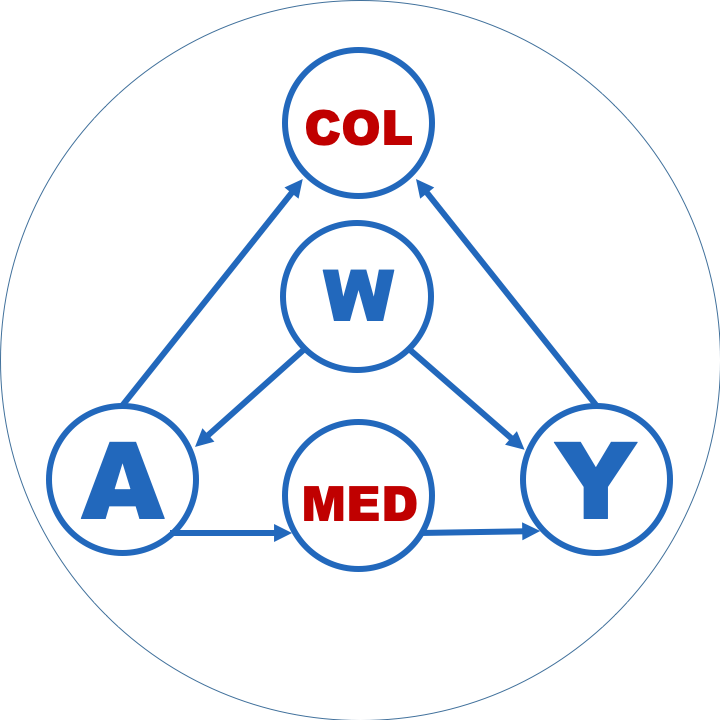
A question often asked by anyone is “what would have happened if we had done this instead?” The answer is impossible to know for certain, but there are mathematical methods that allow us to estimate this answer. These methods are called causal inference. This book introduces the concepts of causal inference from a beginner’s perspective and leads the interested reader to numerous approaches to answer these impossible questions.
The purpose of many health studies is to estimate the effect of an exposure on an outcome. It is not always ethical to assign an exposure to individuals in randomised controlled trials; instead, observational data and appropriate study design must be used. There are major challenges with observational studies, one of which is confounding that can lead to biased estimates of the causal effects. Controlling for confounding is commonly performed by simple adjustment for measured confounders; although, often this is not enough. Recent advances in the field of causal inference have dealt with confounding by building on classical standardisation methods. However, these recent advances have progressed quickly with a relative paucity of computational-oriented applied tutorials, contributing to some confusion in the use of these methods among applied researchers.
In this book, we show the computational implementation of different causal inference estimators from a historical perspective, where different estimators were developed to overcome the limitations of the previous ones. We introduce the potential outcomes framework, illustrate the use of different methods using examples from health care settings, and most importantly, we provide reproducible and commented code in R and Stata for researchers to apply in their own observational studies.
The code can be accessed at github.com/migariane/TutorialCausalInferenceEstimators.
How to cite this book
If you use this book in your research or teaching, please cite it using the following reference:
Luque-Fernandez, M. A., & Smith, M. J. (2026). Computational Causal Inference for Applied Researchers: A Practical Guide for Epidemiologists and Biostatisticians. Universidad de Granada. https://doi.org/10.5281/zenodo.20677995
@book{luque-fernandez2026causal,
  title     = {Computational Causal Inference for Applied Researchers:
               A Practical Guide for Epidemiologists and Biostatisticians},
  author    = {Luque-Fernandez, Miguel Angel and Smith, Matthew J.},
  year      = {2026},
  publisher = {Universidad de Granada},
  doi       = {10.5281/zenodo.20677995},
  url       = {https://migariane.github.io/Causal-Inference-Book}
}
The book is permanently archived on Zenodo. Each release receives a versioned DOI; the badge above resolves to the latest version. For reproducibility, cite the specific DOI of the version you used.
Who this book is for
This book is targeted towards epidemiologists, statisticians, psychologists, economists, sociologists, political scientists, and computer scientists — anyone interested in learning and applying causal inference methods to real-world data.